
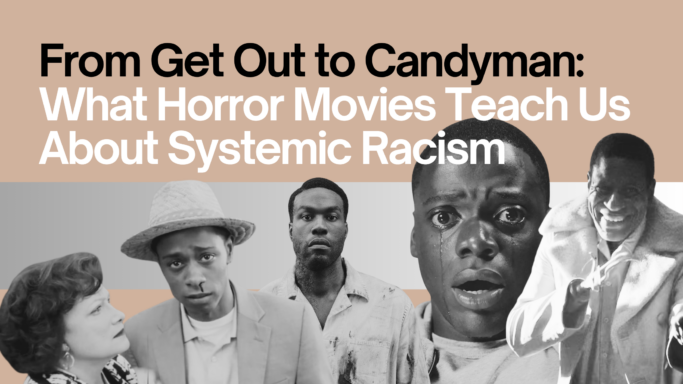
Horror movies and ghost stories are often dismissed as entertainment, yet they provide a platform for narratives that are often overlooked in society. One such narrative is racism, a complex topic that can be difficult to discuss openly with those outside a person’s racial experience. However, films and stories can address this issue in a way that allows viewers to comprehend the horrors of racism without triggering defensiveness, shutting the conversation down. Ghost stories, in particular, offer a lens through which we can examine the past and understand how the Black community has historically experienced racism.
Racism and the Illusion of Safety in Get Out
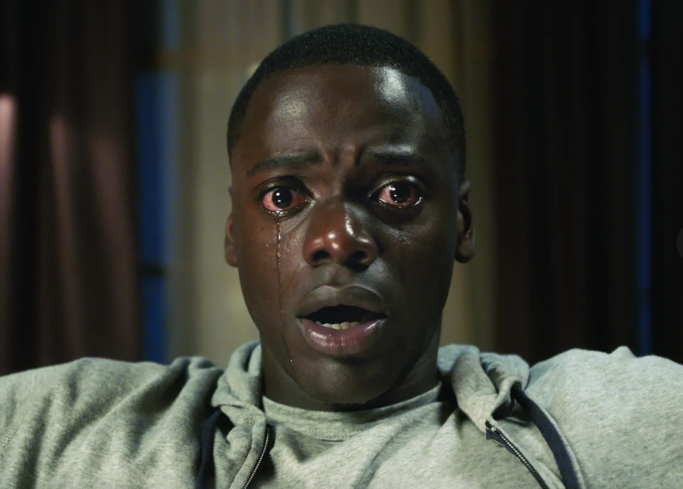
In the movie Get Out, director Jordan Peele uses horror to expose a familiar but often minimized reality – racism that presents itself as polite, progressive, and non-threatening.
A key moment occurs when Rod, Chris’s friend, goes to the police to report Chris missing. His concern is dismissed outright. The officer assumes the situation is not serious, reinforcing a pattern many Black individuals recognize: their fears and warnings are often not believed, even in situations involving real danger.
This dismissal is not incidental. It reflects a broader social dynamic where institutions fail to respond equitably. Within the film, the Armitage family’s treatment of Black bodies as objects to be used mirrors historical patterns of exploitation. Scholar Ayo Coly (author of the book Postcolonial Hauntologies) describes how colonial narratives constructed African bodies as objects of fascination and control. Get Out translates that history into a modern setting, making it visible in ways that are difficult to ignore.
For workplace contexts, this dynamic shows up in perhaps quieter ways – whose concerns are taken seriously, whose experiences are questioned, and whose safety is assumed rather than verified?
Hauntings That Do Not End – Postcolonial Hauntology
In Postcolonial Hauntologies, author Ayo Coly demonstrates how histories of racialized sexualization continue to shape present-day experiences. Like in the case of Saartje (Sara) Baartman, born 1815, an enslaved Khoikhoi woman whose body was used in “freak shows” whilst also being hyper sexualized. Even after Saartje died, her body parts (including her genitals) were kept on display and were only returned and buried in South Africa, near her birthplace, in 2002.
The concept of “haunting” is useful in DEI work because it captures something many policies and frameworks miss – history does not stay in the past. It shows up in perceptions, stereotypes, and expectations that continue to affect how people are treated. Saartje’s dehumanization is still present in today’s anti-fat bias and the hyper sexualisation of Black bodies.
Coly’s work highlights how Black women, in particular, are still navigating narratives rooted in colonial objectification. These are not abstract ideas. They influence hiring decisions, leadership perceptions, and workplace dynamics around credibility and professionalism.
Racism, Memory, and Collective Denial in Candyman
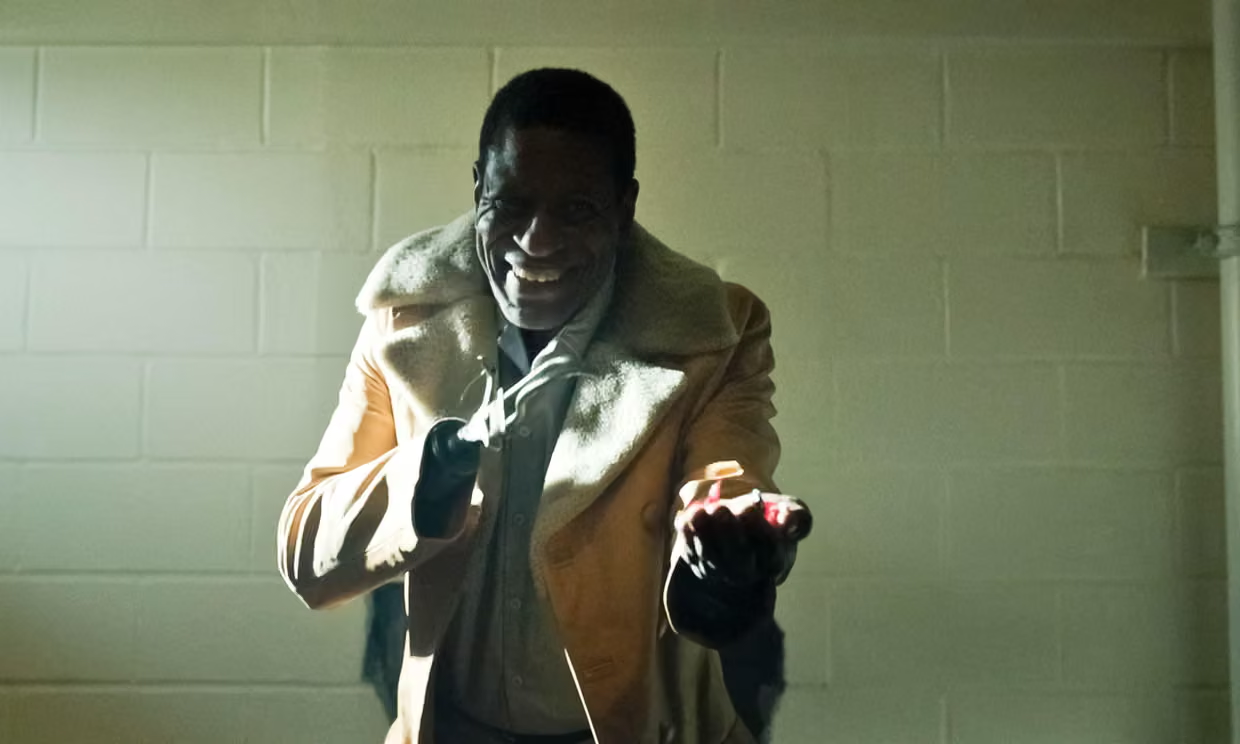
In the 2021 version of the film Candyman, Director Nia DaCosta uses the ghost of Candyman to tell a story of a Black man who is wrongfully killed, highlighting the history of police violence against Black people. The film reimagines the story to represent racial violence and collective memory. The ghost is not simply a figure meant to frighten. It represents histories that have been suppressed or ignored.
The film connects the legend of Candyman to the ongoing realities of police violence and systemic inequities in Black communities. Sociologist Avery Gordon argues that haunting reveals what societies attempt to erase. This narrative is also employed in Percival Everett’s novel, The Trees, where the murderers of Emmett Till, the child who was lynched after a white woman claimed he flirted with her, are turning up dead alongside the body of a man who resembles Emmett Till in present-day Mississippi. In these contexts, the ghosts become a way of understanding how unresolved injustice continues to shape the present.
The gap in perception of our country’s history is critical in workplace equity efforts. When people experience the same reality differently, it affects how harm is recognized, how policies are interpreted, and whether accountability is taken seriously.
Displacement, Belonging, and the Ghosts of Migration
Racism also operates through exclusion and displacement, particularly for immigrants and refugees. In the book The Refugee by Viet Thanh Nguyen, the narrator writes, “In a country where possessions counted for everything, we had no belongings except our stories.” This line captures a key tension in many immigrant experiences – navigating a society that measures worth through systems they have not had equal access to. In the story, the narrator’s mother tells ghost stories to cope with loss. Immigrants are often left to silently confront the ghosts of their past while trying to adapt to a completely new and unfamiliar society.
These experiences are often invisible in professional settings, where assimilation is expected, and personal histories are left unspoken.
For organizations, this raises practical questions about belonging. Inclusion is not only about representation. It involves understanding the histories people bring with them and how those histories shape their engagement, communication, and sense of safety.
Why This Matters for DEI Work
Horror offers a way to engage with racism that is both accessible and difficult to dismiss. It externalizes harm, making patterns easier to see without requiring individuals to disclose their own experiences immediately.
For DEI practitioners, these narratives can be used to:
- Illustrate how systemic issues operate beyond individual intent
- Highlight the gap between perception and lived experience
- Create entry points for conversations that might otherwise feel confrontational
- Connect historical patterns to present-day workplace dynamics
The value is not in the genre itself, but in what it reveals. Racism often operates in ways that are subtle, normalized, or denied. Horror makes those dynamics visible by exaggerating them so they can be recognized, whilst also being entertaining and memorable, as good storytelling often is.
Stories can open the door, but change requires action. Take a closer look at how your organization responds to harm, whose voices shape decisions, and what accountability looks like in practice. And perhaps, a movie night?
Written by
Isha Hussein (she/her)
If you haven’t yet had the opportunity, make sure to order a copy of Elmer Dixon’s powerful memoir DIE STANDING: From Black Panther Revolutionary to Global Diversity Consultant and check out what others have been saying about Elmer and his story.
Check out these other opportunities to see what folks are saying about Elmer and his continued work.
- See Elmer speak at Stories from the Revolutions’ Front Lines at his keynote at TEDxUTulsa
- Listen to Elmer talk on NPR’s The Jefferson Exchange
- Read about Elmer’s story in a piece featured in The Seattle Times
- Listen to Elmer on The Medium